TOPIC: Birds of Tamarack Minnesota and Surrounding Areas
PRESENTER: Jerry Niemi, Retired Professor Emeritus Department of Biology,
University of Minnesota, Duluth
Jerry will provide a summary of the bird species that occur in the Tamarack region. Special emphasis will be placed on species that have been identified by federal, state, or other organizations as species with conservation concerns (e.g., Yellow Rail and Sandhill Crane). The summary will highlight the recent statewide Minnesota Breeding Bird Atlas that was a comprehensive sampling of over 98% of Minnesota's 2,352 townships. These data and many others provide a solid basis for assessing the potential impacts of natural resource development projects such as mining on birds in the region.
Jerry Niemi is a retired Professor Emeritus at the University of Minnesota-Duluth (UM-D). He was formerly Professor of Biology and Director of the Center for Water and the Environment at the Natural Resources Research Institute at UM-D. He received his Ph.D. in Biology at Florida State University in 1983 and was a Fulbright scholar in Finland in 1981. He has authored or co-authored over 170 peer-reviewed papers and over 130 technical reports and popular articles. His research has focused on birds, the Great Lakes ecosystems, conservation, climate change, ecotoxicology, and sustainability in the use of natural resources.
Register for the meeting to receive the Zoom link at tamarackwateralliance.org/php/eventreg.php?eid=16 or from our home page at tamarackwateralliance.org.
Make Your Voice Heard! The Public Comment period for the Talon Tamarack High Sulfide project is now open until September 14, 2026. This is the first formal opportunity for Minnesotans to provide feedback on the project proposal during the environmental review process.
Voice your concerns at Mille Lacs Band Water Over Nickel:
waterovernickel.com/public-comment-resources.
Visit the Tamarack Water Alliance resource page for comments: tamarackwateralliance.org/scoping.html.
Visit the Tamarack Water Alliance page outlining impacts on the St. Louis Bay Estuary: tamarackwateralliance.org/estuary.html.
Visit the Main DNR Talon EIS Site: https://www.dnr.state.mn.us/input/environmentalreview/tamarack-nickel-project.html.
Download the Project Scoping Document: https://files.dnr.state.mn.us/input/environmentalreview/tamarack-nickel/2026-07-07-tal-draft-scoping-decision-document.pdf.
REQUEST Presentation On Risks of Sulfide Mining for your group, Rotary Club, church or community club. Send us an email at waters@tamarackwateralliance.org.
DOWNLOAD Tamarack Water Alliance fact sheets/flyers here
(https://tamarackwateralliance.org/resources.html#flyers).
SIGN-UP To Receive Updates from the DNR on Talon Metals Environmental Impact Statement here here (https://www.dnr.state.mn.us/input/environmentalreview/tamarack-nickel-project.html).
VOLUNTEER with the Tamarack Water Alliance. Send us an email at waters@tamarackwateralliance.org.
SIGN-UP FOR THIS NEWSLETTER: Encourage your friends, family and neighbors to sign up for the monthly Tamarack Water Alliance email newsletter at tamarackwateralliance.org/php/articlereg.php.
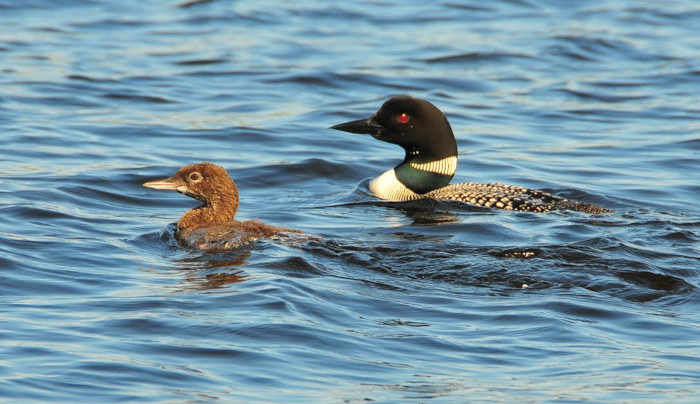 Loonlet and Adult Loon by Jarad Niemi
There are many potential impacts from any natural resource development and sulfide mining is no exception. Among the first questions to be addressed is what natural resources may be affected by a development. To address this question, I will focus on a broad overview of the primary bird species that could be impacted by sulfide mining being proposed near Tamarack, Minnesota.
Highly Diverse Avifauna Due to Varying Habitats
The Tamarack region has a highly diverse avifauna due to the mosaic of habitats ranging from extensive open water in lakes, wetland complexes, forests of many age classes and cover types, and human settlements. I reviewed the available public resources to identify bird species that have been documented to occur in the Tamarack region with a focus on birds breeding or likely to be nesting in the area. For example, in a review of a 10-mile radius centered on the Talon mine site revealed that 129 bird species were detected during the 2009-2013 Minnesota's breeding bird atlas. I also considered other species that are likely to use the area during migration or winter. The species consisted of waterfowl, game birds, rails, shorebirds, herons and bitterns, raptors, woodpeckers, flycatchers, and many songbird species that were confirmed nesting, likely to be nesting, or observed within this area. These data illustrate the high diversity of birds in the region compared with areas dominated by human development or agriculture.
What is important from the perspective of potential impacts from a development is to identify species that are vulnerable to harm from a proposed development. The Minnesota Department of Natural Resources in their Wildlife Action Plan for 2025 to 2035 identified 79 bird species that occur in Minnesota and are of special conservation concern. These are state or federally Endangered or Threatened species, Minnesota Special Concern species, Minnesota Species of Greatest Conservation Need, or Species in Need of Information. The goal of the MNDNR's Wildlife Action Plan is to conserve these identified species through targeted action.
Comparison of MN DNR List of 77 Species with 33 in Tamarack
A total of 33 bird species found in the Tamarack region were on the MN DNR list (33 of 79 (42%). Even though there were no bird species that are designated as federal or state Endangered or Threatened, it is a relatively high percentage and highlights the high diversity of birds in the Tamarack region. There were 7 species that were both Minnesota designated as Species of Special Concern and Species of Greatest Conservation Need that occur in the area: American Goshawk (migration or winter), Boreal Owl (winter), Forster's Tern, Nelson's Sparrow, Purple Martin, Short-eared Owl, and Yellow Rail. There were an additional 26 species that were designated as Species of Greatest Conservation Need. These species include the American Bittern, American Kestrel, Black Tern, Bobolink, Bufflehead, Canvasback, Cape May Warbler, Chimney Swift, Common Loon, Common Nighthawk, Eastern and Western Meadowlark, Evening Grosbeak, Golden-winged Warbler, Great Gray Owl, Least Bittern, Leconte's Sparrow, Lesser Scaup, Northern Harrier, Northern Pintail, Olive-sided Flycatcher, Red-headed Woodpecker, Sedge Wren, Sharp-tailed Grouse, Swainson's Thrush, and Upland Sandpiper.
Many Bird Species Populations Susceptible to Mining in Tamarack
In summary, there are many bird species that are potentially susceptible to population changes in the Tamarack region that should be considered in the development of sulfide mining activities. These species need to be evaluated on their exposure to the stressors that will occur from mining activity including changes in air, land, and water. Land use changes include indirect effects on their food sources, and alterations to the surrounding landscape.
The effects on these species require a detailed examination of changes in land use and landscapes configurations, water quantity and quality, noise, light, and potentially other stressors resulting from mining activity. Each bird species has their own ecological and toxicological tolerances to the changes that will occur in the Tamarack environment. I will review the status and causes for conservation concern for many of these species such as the Common Loon, Golden-winged Warbler, Sharp-tailed Grouse, and Yellow Rail that have rendered them vulnerable in Minnesota.
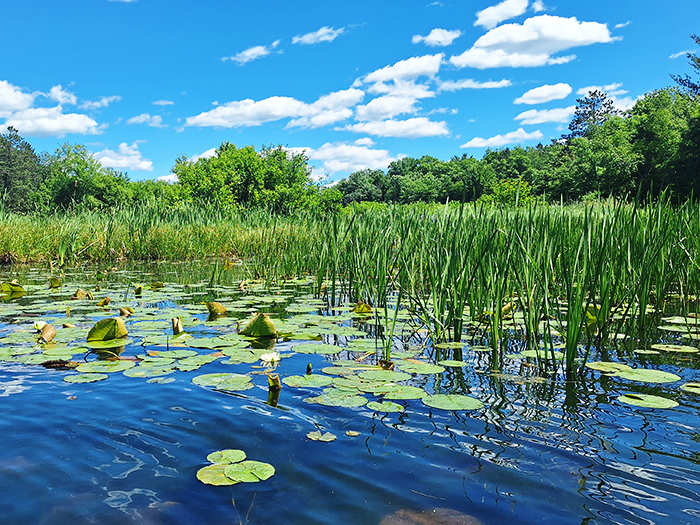 Water Lilies - Lynn Anderson
Tamarack Mine Offers Questions, Fewer Answers
From Winona LaDuke, Ojibwe writer and economist from White Earth Reservation, and co-curator of the Giiwedinong Museum in Park Rapids, MN :
"The lakes and waters of Minnesota are related, linked by underground currents, and a delicate and lush ecosystem which exists nowhere else on the continent. That water and these wetlands, from the Boundary Waters to Sandy Lake, are in danger of destruction by a set of foreign corporations.'"
"...Take the case of the proposed Talon Metals mine in Tamarack. The Minnesota DNR is taking comments right now about issuing permits for a project which is a fantasy of made up ideas as to what will happen to the mined ore..."
..."A set of foreign corporations, Canadian and British, have hatched a plan to haul 12 million tons of high grade ore out of the Tamarack mining project to someplace to make something...First, there is a pretend plan. Those minerals will allegedly be turned into batteries for electric vehicles. There is no location to produce these batteries in the United States... Second, there is no plan for the acid mine drainage. Copper and nickel are bonded to sulfur to create acid mine drainage. These sites end up as superfund sites - and the largest percentage of superfund sites are these mines..."
..."Third, mining sucks water. Talon Metals hopes to pump 2.6 million gallons of water daily from the aquifer for a decade. Yikes. That's going to lower lake levels and dry up wetlands. There is no plan for remediation...The Talon metals site is the wettest site ever proposed for a nickel sulfide mine..."
..."This past week, Anishinaabe and many others gathered to honor the waters and also Sandy Lake, one of the most historic lakes to the Anishinaabe people. The DNR is taking comments here: https://www.dnr.state.mn.us/input/environmentalreview/tamarack-nickel-project.html."
LaDuke, Winona, August 5, 2026, Duluth News Tribune
https://www.duluthnewstribune.com/opinion/columns/laduke-tamarack-mine-offers-several-questions-fewer-answers
Tamarack Water Alliance is a group of local residents and landowners working together with others from across Minnesota to protect water and community health from the dangers of sulfide mining near our beloved lakes and wild rice beds, at the headwaters of the Kettle River and in the Mississippi River watershed. Visit our website here (https://tamarackwateralliance.org/index.html).
A proposal by a foreign owned mining company, Talon Metals/Rio Tinto to mine nickel and other metals near Tamarack in Aitkin County threatens the health of our communities. This kind of sulfide mining, especially in water-rich environments, has never been done without severe impacts to water and the health of those downstream. Mining here is also a threat to environmental justice and the long-term economic security of nearby native and rural communities.
Review our community slide presentation (tamarackwateralliance.org/docs/TamarackMineConcerns-Consolidated.pdf) and download informative flyers (tamarackwateralliance.org/resources.html):
We will send this monthly newsletter to keep you informed about this project, to share information and opportunities to act to protect clean water and community health.
Copyright . Tamarack Water Alliance. All Rights Reserved.